Well it's been a while. Since the last post we have made hay, started irrigating, had the Grand children for a visit and presently have my wife's parents with us.
The hay was a poor crop and typical of many of the older stands around, due to a cold dry spring and then a quick jump in temperatures the crop was light with only half the normal bales. This means we are watering and hoping for a good 2nd and 3rd cut or we will be short of winter feed. The pasture is doing well though and the lambs are starting to fill out. Rosa our Guardian dog is now very well adjusted, and is a great dog, doing all the right things for a change!
The garden is coming along but with the strange spring weather not all plants grew as they should. There will be few carrots and parsnips this year and very few cauliflowers and broccoli. Needless to say we shall still be up to our armpits in zucchini and beans!
I have always been a keen veg grower, but just for the house. With all this hundred mile diet and so many people in our area looking for local produce I have had to do some soul searching. So I hitched up the discs and chisel plow and ripped up half acre of pasture on the south side of the barns to prepare a market garden for next season. I know this is too small for a serious venture but I would like to start small, if it works I have 4 acres next to it to get serious with.
I plan to keep cultivating it and irrigating it till mid August, that should keep the weeds at bay and deplete some of the weed seed bank. Then sow fall rye as a cover crop and in mid October cover it all with sheep manure compost and work it all in ready for next springs planting.
We are presently checking out the area Farmers Markets to see what sells and if there are any niches open to us. The farmer that I am means that I like to plant big seeds into the dirt and stand back. Though I think I will have to get more technical and do the whole transplanting thing and may be at a later date a greenhouse. For now I will need a nice hoe to lean on instead of my shepherds crook, though the wife says I have to weed with it , whats with that?
Tuesday, July 14, 2009


Sunday, June 21, 2009
Smart Dogs


Several weeks ago I took a day off and the wife and I went up into one of the side valleys near us to watch some sheepdog trials. It was a beautiful sunny day and being high up the mountain we caught the sun and came back glowing. Folks were there to compete from all over western Canada and north western US. Most of the dogs performed well, though the odd one had stage fright and was a 'no show'. One thing I noticed was that 80-90% of the handlers were women which suprised me , as while growing up in England it was the opposite, well done ladies.We watched for several hours and had a very enjoyable time watching other people work! We travelled in a circular route so we could explore some valleys we had not yet seen. We have tried to do that lately and the more we see the more we realize we bought our farm in the right location. Close to town on a black top road, plenty of water for irrigation and low elevation for more heat units.Now we just have to find a crop to utilize these attributes that is profitable and legal!!
Tuesday, June 16, 2009
Over the River


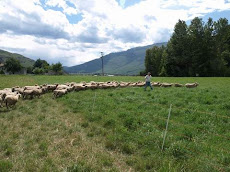
The river running through our land is thankfully crossed on our property line by a nice walled goverment bridge which we use when moving stock from one side to the other. When we had cattle it involved more muscle power as steel panels were needeed to block off the road and steer the cattle. Now with sheep we find it so much easier and when they have done it once they know there is fresh pasture on the other side as the sequence of photos show. It was all I could do to stay ahead of them and they still beat me to the far side of the bridge. Note Rosa our guardian dog leads the way and is ahead in the pasture as well. We cross the river about eight times a year and it only takes a few minutes so we rarely hold up the traffic.
Monday, May 25, 2009
Raw Material Economics
The opinion below appeared in the Globe and Mail newspaper today 25th May under the heading " We can't keep offering cheap calories to the consumers." It seems the business world is worried about profitability in the agri food sector along with the retailers, shippers and manufactures but not a word about sustainability of the farmers who are paid 1960s prices. We are the goose that lays the golden egg but we can't keep laying with out some feed!! Big food has made money by cutting costs at the farm gate for raw commodities so as to give cheap food to the masses thus ensuring continued disposable income for all the other stuff our society thinks it needs and big business makes to sell them at inflated profits. If we had to pay 20, 30 or 40% of our income on food like days gone by and the increase showed up at the farm gate I feel us farmers might smile a little more often and this one may well trade in his 17 year old Volvo for something a little newer! Raw materials are the fly wheel of any economy, pay the true value for them ( ie Parity, costs plus wages plus retirement contributions )and the rest will take care of its self. Any costs for food safty are passed down to the farmer in lower crop prices to cover the agrifood sectors costs.
The article in full below, there are good points but the farmer who makes it all happen seems to be left out!
Once again, the only price category that showed any signs of upward pressure in April was food. Although food prices in retail stores have gone up by 8.3 per cent in the past year, a broader perspective on global market conditions indicates Canada is actually in a good situation. Not only are we better positioned than most countries to absorb adverse economic developments, but higher prices become investments in food industries, local and global, that sorely need redevelopment to deal with problems such as food safety and production efficiency.
Food remains cheap in Canada and has been for decades. Canadian households barely spend 10 per cent on food every year. Thirty years ago, the figure was between 25 and 30 per cent. Food prices at retail in other industrialized countries are much higher than they are in Canada. Market conditions are even worse in developing countries. In a poll of developing countries published recently, a majority of people in nearly all of them say that rising food costs have negatively affected them.
Higher food prices are desirable for two reasons. The first is food safety. Because of food recalls of wide scope in recent years, safety is becoming a critical issue for governments and the private sector. We are asking agrifood companies to spend more on traceability systems, conduct more inspections and apply rigorous protocols. All these initiatives cost money.
It is increasingly challenging for the industry to focus on new safety initiatives when it does not have access to more wealth. For years, we have seen companies change their cost structure and develop centralized operations in order to offer cheap calories to consumers. In addition, global trade is making distribution systems highly complex. As consumers, if we want our food to be safeguarded, we should expect to pay more. The latest polls on this subject, however, suggest consumers are still not willing to do so. That will need to change before Canada gets hit by a food safety catastrophe.
The second reason for higher food prices is capital investments. After commodity price hikes last year, fertilizer companies embarked upon major expansion projects. Mosaic, Agrium and Potash Corp. all announced projects as a result of increasing potash prices, a major component for soil fertilizers.
Potash prices rose significantly last year for one reason: Demand for fertilizers was up because farmers wanted to grow more efficiently. At the same time, farmers naturally wanted higher yields because commodity prices were higher.
Rapid economic growth in developing economies such as China is creating a transitory imbalance: too much demand, not enough supply. With more fertilizers, world agriculture will be capable of producing more, and doing so will eventually stabilize commodity and food prices at retail for the longer term.
In Canada, if we want affordable food in the future, prices at retail need to increase at a reasonable pace in the present. This may seem counter intuitive, but higher prices will bring more investments and allow developing countries to build production capacity.
If this happens, an increase in supply will eventually force prices to decrease. Canada, the biggest producer of potash in the world, has a definite role to play in improving global food production.
In the recent past, low food prices at retail have compelled the industry to do more with less. As a result, we have had little or no innovation, more food-borne illnesses, more poor farmers and fewer capital investment projects.
Now, food is regularly in the headlines and paradigms are finally shifting toward food consciousness. More wealth within the industry will be beneficial for the common good. Organic and fair-trade products will become more attractive because the gap between retail prices of conventional food products and those of premium items is diminishing.
Canadian-based biotechnology firms may also find bigger footholds in world agricultural markets for which they can provide sound, genetically engineered products.
But higher prices alone are not the food industry's redemption. This shift in prices invites consumers to rethink how they consume food and how they perceive the meaning of nutrition in their lives. Higher prices may hurt some consumers at first, but we need to invest in the future of food in order to benefit both consumers and the agrifood industry.
Sylvain Charlebois is associate dean, Kenneth Levene Graduate School of Business at the University of Regina.
Join the Discussion:
Sorted by: Oldest first
Latest Comments
The article in full below, there are good points but the farmer who makes it all happen seems to be left out!
Once again, the only price category that showed any signs of upward pressure in April was food. Although food prices in retail stores have gone up by 8.3 per cent in the past year, a broader perspective on global market conditions indicates Canada is actually in a good situation. Not only are we better positioned than most countries to absorb adverse economic developments, but higher prices become investments in food industries, local and global, that sorely need redevelopment to deal with problems such as food safety and production efficiency.
Food remains cheap in Canada and has been for decades. Canadian households barely spend 10 per cent on food every year. Thirty years ago, the figure was between 25 and 30 per cent. Food prices at retail in other industrialized countries are much higher than they are in Canada. Market conditions are even worse in developing countries. In a poll of developing countries published recently, a majority of people in nearly all of them say that rising food costs have negatively affected them.
Higher food prices are desirable for two reasons. The first is food safety. Because of food recalls of wide scope in recent years, safety is becoming a critical issue for governments and the private sector. We are asking agrifood companies to spend more on traceability systems, conduct more inspections and apply rigorous protocols. All these initiatives cost money.
It is increasingly challenging for the industry to focus on new safety initiatives when it does not have access to more wealth. For years, we have seen companies change their cost structure and develop centralized operations in order to offer cheap calories to consumers. In addition, global trade is making distribution systems highly complex. As consumers, if we want our food to be safeguarded, we should expect to pay more. The latest polls on this subject, however, suggest consumers are still not willing to do so. That will need to change before Canada gets hit by a food safety catastrophe.
The second reason for higher food prices is capital investments. After commodity price hikes last year, fertilizer companies embarked upon major expansion projects. Mosaic, Agrium and Potash Corp. all announced projects as a result of increasing potash prices, a major component for soil fertilizers.
Potash prices rose significantly last year for one reason: Demand for fertilizers was up because farmers wanted to grow more efficiently. At the same time, farmers naturally wanted higher yields because commodity prices were higher.
Rapid economic growth in developing economies such as China is creating a transitory imbalance: too much demand, not enough supply. With more fertilizers, world agriculture will be capable of producing more, and doing so will eventually stabilize commodity and food prices at retail for the longer term.
In Canada, if we want affordable food in the future, prices at retail need to increase at a reasonable pace in the present. This may seem counter intuitive, but higher prices will bring more investments and allow developing countries to build production capacity.
If this happens, an increase in supply will eventually force prices to decrease. Canada, the biggest producer of potash in the world, has a definite role to play in improving global food production.
In the recent past, low food prices at retail have compelled the industry to do more with less. As a result, we have had little or no innovation, more food-borne illnesses, more poor farmers and fewer capital investment projects.
Now, food is regularly in the headlines and paradigms are finally shifting toward food consciousness. More wealth within the industry will be beneficial for the common good. Organic and fair-trade products will become more attractive because the gap between retail prices of conventional food products and those of premium items is diminishing.
Canadian-based biotechnology firms may also find bigger footholds in world agricultural markets for which they can provide sound, genetically engineered products.
But higher prices alone are not the food industry's redemption. This shift in prices invites consumers to rethink how they consume food and how they perceive the meaning of nutrition in their lives. Higher prices may hurt some consumers at first, but we need to invest in the future of food in order to benefit both consumers and the agrifood industry.
Sylvain Charlebois is associate dean, Kenneth Levene Graduate School of Business at the University of Regina.
Join the Discussion:
Sorted by: Oldest first
Latest Comments
Thursday, May 7, 2009
NEW
Our son came home from University and decided our Harmonious Homestead and Ewe blog site for our Agritourism venture needed an over haul. Link to it on the left hand side of this page and check it out. We think it looks great, with much new text and updated photos, puts the Folly to shame!
Update
We have almost finished lambing now , just two more to go. We are still holding the sheep off pasture, at least till Sunday, then we will be out of hay and will start grazing. Our open days have been going well with two more left we will be glad of a rest. Folks really enjoy the interaction with the animals and "kids" of all ages enjoy bottle feeding and playing with the lambs. Answering the many questions is fun and sometimes challenging though as a life time farmer it scares me how big the urban rural gap has become. On the prairies many people have family that still farm so are at least familiar with land and livestock, but here in BC many folks are several generations removed from the land and it shows in the questions and misunderstandings that we heard. This makes us realise the important task at hand and ahead to not only entertain but also educate all ages so as to fill in the huge gap between their plate and our farm gate.
The chicks that were little fluff balls for our first open day are now ugly half feathered teenage chickens, and after making another "chicken tractor" for them they are now outside weeding the grass in our young orchard, moved once a day they are doing a nice weed and feed job. Our goats are doing well and producing milk for our orphan lambs as well as raising their own kids. At noon I shut the does up away from the kids till after supper then milk them before reuniting them, this means there is a good supply of milk and I only have to milk once a day.
The lambing went well as many of the ewes are old hands, we had 8 sets of triplets and one set of quads, many twins and only a few singles, either from first time lamber's or old ewes. With this many multiple births we only had 4 bottle fed lambs (thank goodness) and a first in all my years, several sets of premature lambs, all of which were born fine but with no wool until at least 2 weeks of age. We did loose a couple early on due to poorly developed lungs but the rest are out with the main flock and doing fine. This is the first year I did not inject the pregnant ewes with Selenium Vitamin E three weeks before lambing and I suspect this may be the cause of the premature births. Selenium increases the level of Oxygen in the blood in the ewe and unborn lambs making birthing and "cleansing " of after birth easier as well as producing more vigorous lambs. This may well have caused the early births, so next year I will not be so cheap and use the S and E again. Any other stock men or Vets out there with comments I would love to hear from you.
With grazing only a few days away I will be sorting out electric fencing equipment and setting up the first few paddocks. Thankfully last night we had our first decent rain since March so the grass should start growing quicker now. Her is to a green spring for all the graziers out there.
The chicks that were little fluff balls for our first open day are now ugly half feathered teenage chickens, and after making another "chicken tractor" for them they are now outside weeding the grass in our young orchard, moved once a day they are doing a nice weed and feed job. Our goats are doing well and producing milk for our orphan lambs as well as raising their own kids. At noon I shut the does up away from the kids till after supper then milk them before reuniting them, this means there is a good supply of milk and I only have to milk once a day.
The lambing went well as many of the ewes are old hands, we had 8 sets of triplets and one set of quads, many twins and only a few singles, either from first time lamber's or old ewes. With this many multiple births we only had 4 bottle fed lambs (thank goodness) and a first in all my years, several sets of premature lambs, all of which were born fine but with no wool until at least 2 weeks of age. We did loose a couple early on due to poorly developed lungs but the rest are out with the main flock and doing fine. This is the first year I did not inject the pregnant ewes with Selenium Vitamin E three weeks before lambing and I suspect this may be the cause of the premature births. Selenium increases the level of Oxygen in the blood in the ewe and unborn lambs making birthing and "cleansing " of after birth easier as well as producing more vigorous lambs. This may well have caused the early births, so next year I will not be so cheap and use the S and E again. Any other stock men or Vets out there with comments I would love to hear from you.
With grazing only a few days away I will be sorting out electric fencing equipment and setting up the first few paddocks. Thankfully last night we had our first decent rain since March so the grass should start growing quicker now. Her is to a green spring for all the graziers out there.
Not so young, not so old.

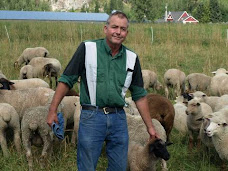
The old owner of the Suffolk sheep we bought last year came for a visit during lambing to see how things were going. They still remembered his sheep call and looked up when they heard him speak Farsi, which could explain why they never pay any attention to me, I speak a foreign language to them! John showed that you did not have to be a kid to enjoy bottle feeding lambs and that proves our open days are for the young and young at heart.
Subscribe to:
Comments (Atom)